droughtevents provides tools to detect, summarize, and
visualize drought events from drought-related index time series (e.g.,
SPEI, SPI). Given a time series and a threshold, the package identifies
periods of sustained below-threshold values, computes summary statistics
for each event (duration, intensity, severity, timing), and offers
ggplot2-based plotting functions to visualize the time
series and highlight the detected events.
You can install the development version of droughtevents
from GitHub with:
# install.packages("remotes")
remotes::install_github("ajpelu/droughtevents")library(droughtevents)
library(ggplot2)droughts() identifies drought events in a time series
when a given index falls below a specified threshold for at least
min_duration consecutive months (2 by default).
data(spei_granada)

result <- droughts(spei_granada, vname = "spei12", threshold = -1.28)

result$drought_assessment
#> # A tibble: 17 × 9
#>    index_events d_duration d_intensity d_severity lowest_spei month_peak minyear
#>           <int>      <dbl>       <dbl>      <dbl>       <dbl>      <dbl>   <dbl>
#>  1            3         11       -1.93       21.2        -2.3         10    1945
#>  2            5          4       -1.45        5.8        -1.6          5    1949
#>  3            7          2       -1.45        2.9        -1.5         12    1950
#>  4           11          2       -1.35        2.7        -1.4          6    1965
#>  5           21         14       -1.83       25.6        -2.2         10    1994
#>  6           23          9       -1.63       14.7        -1.9          6    1998
#>  7           27          7       -1.64       11.5        -1.7          7    2005
#>  8           29          9       -1.92       17.3        -2.2          8    2012
#>  9           31          5       -1.38        6.9        -1.5          5    2014
#> 10           33          5       -1.64        8.2        -1.9          3    2015
#> 11           35          3       -1.5         4.5        -1.7         10    2016
#> 12           37         11       -1.6        17.6        -2.1         12    2017
#> 13           39         11       -1.7        18.7        -2           10    2019
#> 14           41          2       -1.5         3          -1.7         12    2020
#> 15           43         21       -1.58       33.2        -2.1          1    2021
#> 16           45         12       -1.91       22.9        -2.4          1    2023
#> 17           47          5       -1.54        7.7        -1.7          9    2024
#> # ℹ 2 more variables: maxyear <dbl>, rangeDate <chr>
The returned object is a named list with three elements:
data: the original data, with drought flags and
durations added.drought_events: only the rows that belong to a detected
drought event.drought_assessment: one row per event, with its
duration, intensity, severity, and timing.plot_drought_ts() draws the index as a bar plot,
coloring positive (wet, blue) and negative (dry, red)
periods differently.
plot_drought_ts(spei_granada, vname = "spei12", title = "SPEI-12 Time Series")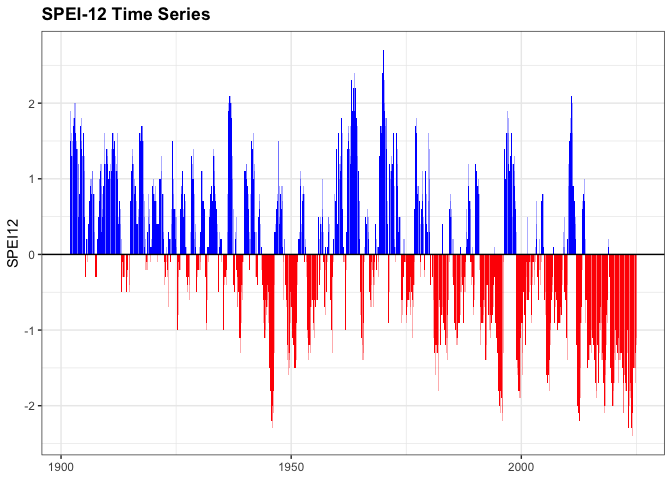
You can also aggregate by year:
plot_drought_ts(spei_granada, vname = "spei12", by_year = TRUE)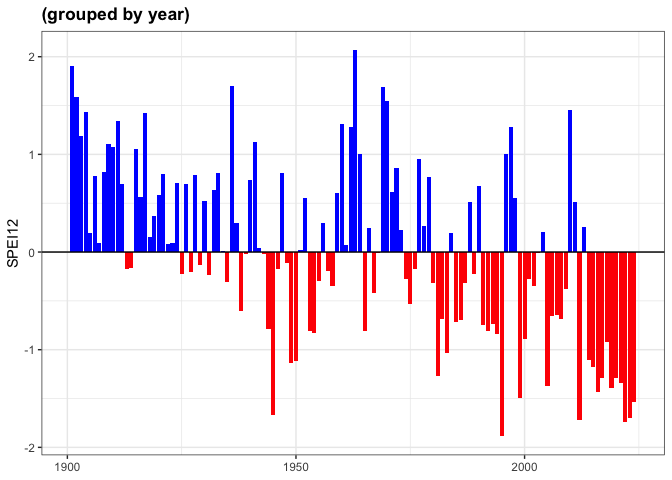
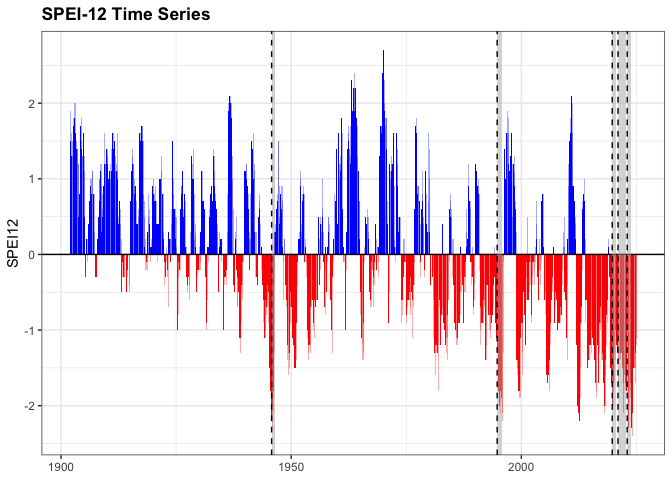
add_drought_events() overlays the detected events on top
of a plot created with plot_drought_ts(), as shaded bands
or vertical lines, or both.
p <- plot_drought_ts(spei_granada, vname = "spei12", title = "SPEI-12 Time Series")

p |>
  add_drought_events(
    drought_assessment = result$drought_assessment,
    which_events = "top",
    metric = "severity",
    top_n = 5,
    type = "both",
    show_severity = FALSE
  )
The package ships with spei_granada, a monthly SPEI time
series (6, 12, 24, and 48-month scales) for Granada, Spain, covering
1901-2024. See ?spei_granada for details and the data
source.
Vicente-Serrano, S.M., Beguería, S., López-Moreno, J.I. (2010). A Multiscalar Drought Index Sensitive to Global Warming: The Standardized Precipitation Evapotranspiration Index. Journal of Climate, 23(7), 1696-1718. 10.1175/2009JCLI2909.1