The goal of forestploter is to create publication-ready
forest plots with minimal effort. This package offers more flexibility
and customization options compared to other packages. The layout of the
forest plot is determined by the provided dataset, and its elements are
organized in a grid-like structure of rows and columns, much like a
table. This design allows for easy manipulation of any plot component.
For instance, the width of the confidence interval column can be
controlled by adjusting the number of spaces in a blank character
column.
You can install the development version of forestploter
from GitHub
with:
Install from CRAN
install.packages("forestploter")Install development version from GitHub
# install.packages("devtools")
devtools::install_github("adayim/forestploter")The column names of the provided data will be used as the header of
the plot. forest() draws the table and the confidence
intervals. The rest is added with the pipe |>:
set_xaxis() sets the limits, tick marks and scale of
the x-axis, and adds vertical lines.set_labs() sets the title, x-axis labels, footnote,
arrow labels and legend labels.scale_sizes() scales the point sizes by study
weights.forest_style() and set_style() set the
graphical parameters.This is a basic example that demonstrates how to create a
forestplot:
library(grid)
library(forestploter)

dt <- read.csv(system.file("extdata", "example_data.csv", package = "forestploter"))

# Indent the subgroup if there is a number in the placebo column
dt$Subgroup <- ifelse(is.na(dt$Placebo),
                      dt$Subgroup,
                      paste0("   ", dt$Subgroup))

# NA to blank
dt$Treatment <- ifelse(is.na(dt$Treatment), "", dt$Treatment)
dt$Placebo <- ifelse(is.na(dt$Placebo), "", dt$Placebo)
dt$se <- (log(dt$hi) - log(dt$est))/1.96

# Add a blank column for the forest plot to display CI.
# Adjust the column width with space.
dt$` ` <- paste(rep(" ", 20), collapse = " ")

# Create confidence interval column to display
dt$`HR (95% CI)` <- ifelse(is.na(dt$se), "",
                             sprintf("%.2f (%.2f to %.2f)",
                                     dt$est, dt$low, dt$hi))

# Define a style, it can be reused for other plots
st <- forest_style(base_size = 10,
                   arrow_type = "closed",
                   footnote = gpar(col = "blue", cex = 0.6))

p <- forest(dt[,c(1:3, 20:21)],
            est = dt$est,
            lower = dt$low,
            upper = dt$hi,
            sizes = dt$se,
            ci_column = 4,
            ref_line = 1,
            style = st) |>
  set_xaxis(xlim = c(0, 4), ticks_at = c(0.5, 1, 2, 3)) |>
  set_labs(arrow = c("Placebo Better", "Treatment Better"),
           footnote = "This is the demo data. Please feel free to change\nanything you want.")

# Print plot
plot(p)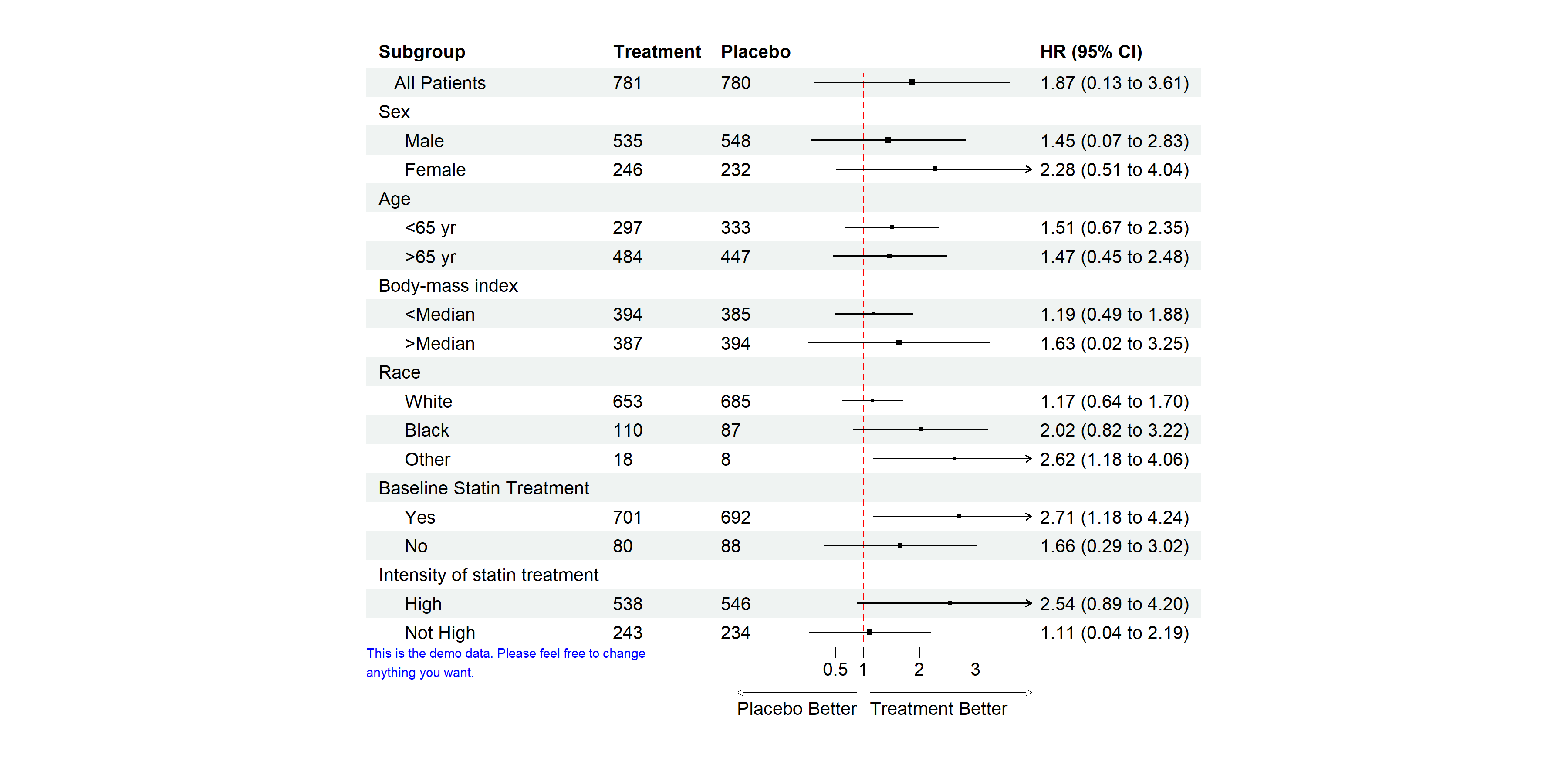
The plot is a gtable, so it can be saved with
ggplot2::ggsave() and combined with other plots, for
example with patchwork::wrap_elements(). Set
fit in forest_style() to let the plot fill the
space it is given. The arguments of forest() used before
version 1.2.0, such as xlim or footnote, and
themes created with forest_theme() still work. The old
arguments give a message pointing to set_xaxis() or
set_labs(), and ?forest_theme shows how the
theme settings map onto forest_style().
You may want to change the color or font of certain columns, insert
text into specific rows, or add an underline to separate groups. The
edit_plot, add_text, insert_text,
and add_border functions are designed for these purposes.
They can be chained with the pipe as well, after
set_xaxis(), set_labs(),
scale_sizes() and set_style(), which build the
plot again:
g <- p |>
  # Edit text in row 3
  edit_plot(row = 3, gp = gpar(col = "red", fontface = "italic")) |>
  # Bold grouping text
  edit_plot(row = c(2, 5, 8, 11, 15, 18),
            gp = gpar(fontface = "bold")) |>
  # Insert text at the top
  insert_text(text = "Treatment group",
              col = 2:3,
              part = "header",
              gp = gpar(fontface = "bold")) |>
  # Add underline at the bottom of the header
  add_border(part = "header", row = 1, where = "top") |>
  add_border(part = "header", row = 2, where = "bottom") |>
  add_border(part = "header", row = 1, col = 2:3,
             gp = gpar(lwd = 2)) |>
  # Edit the background of row 5
  edit_plot(row = 5, which = "background",
            gp = gpar(fill = "darkolivegreen1")) |>
  # Insert text
  insert_text(text = "This is a long text. Age and gender summarised above.\nBMI is next",
              row = 10,
              just = "left",
              gp = gpar(cex = 0.6, col = "green", fontface = "italic")) |>
  add_border(row = 10, col = 1:3, where = "top")

plot(g)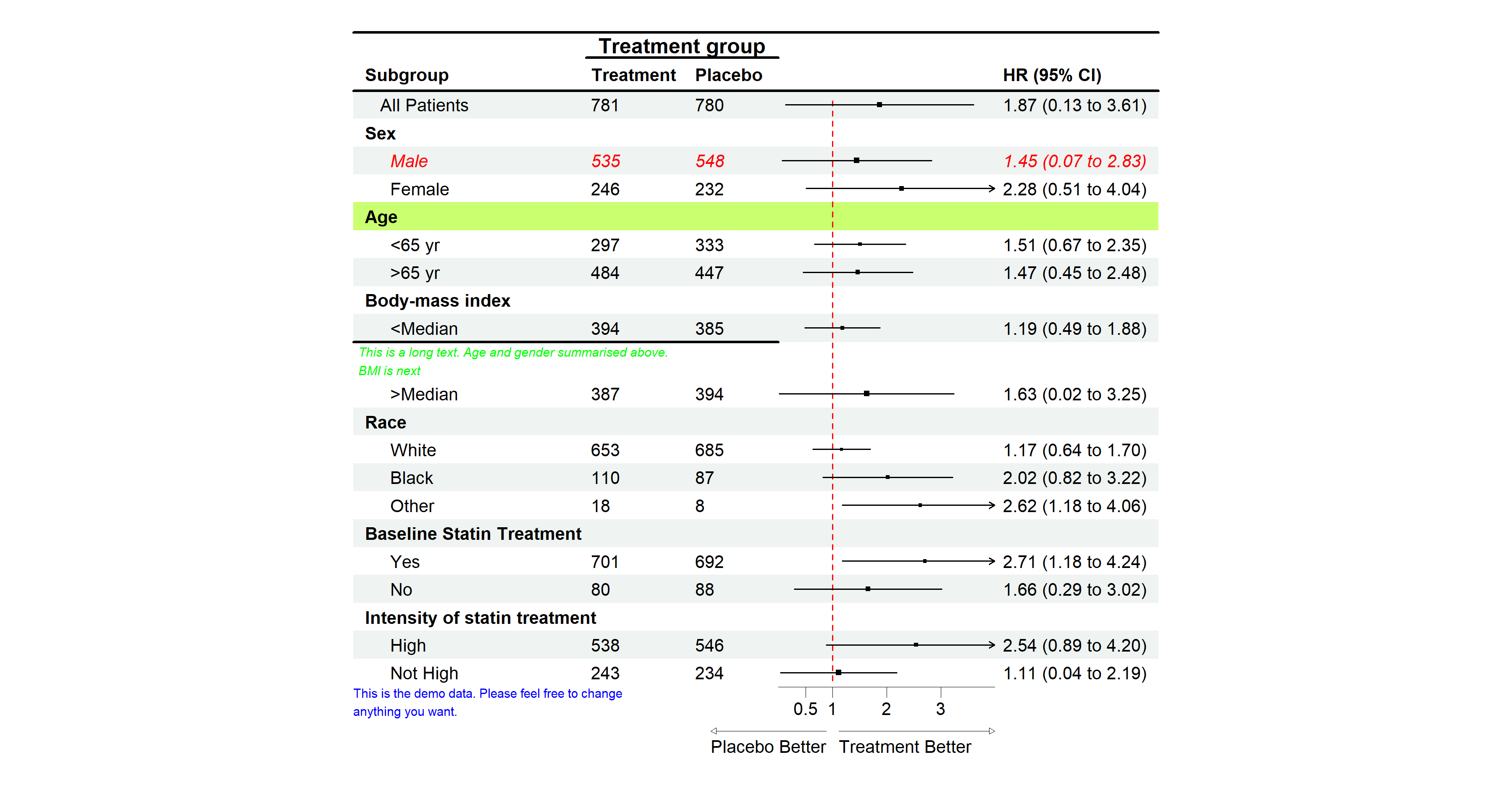
Remember to add 1 to the row number if you have inserted any text before, as the row number will change after inserting text.
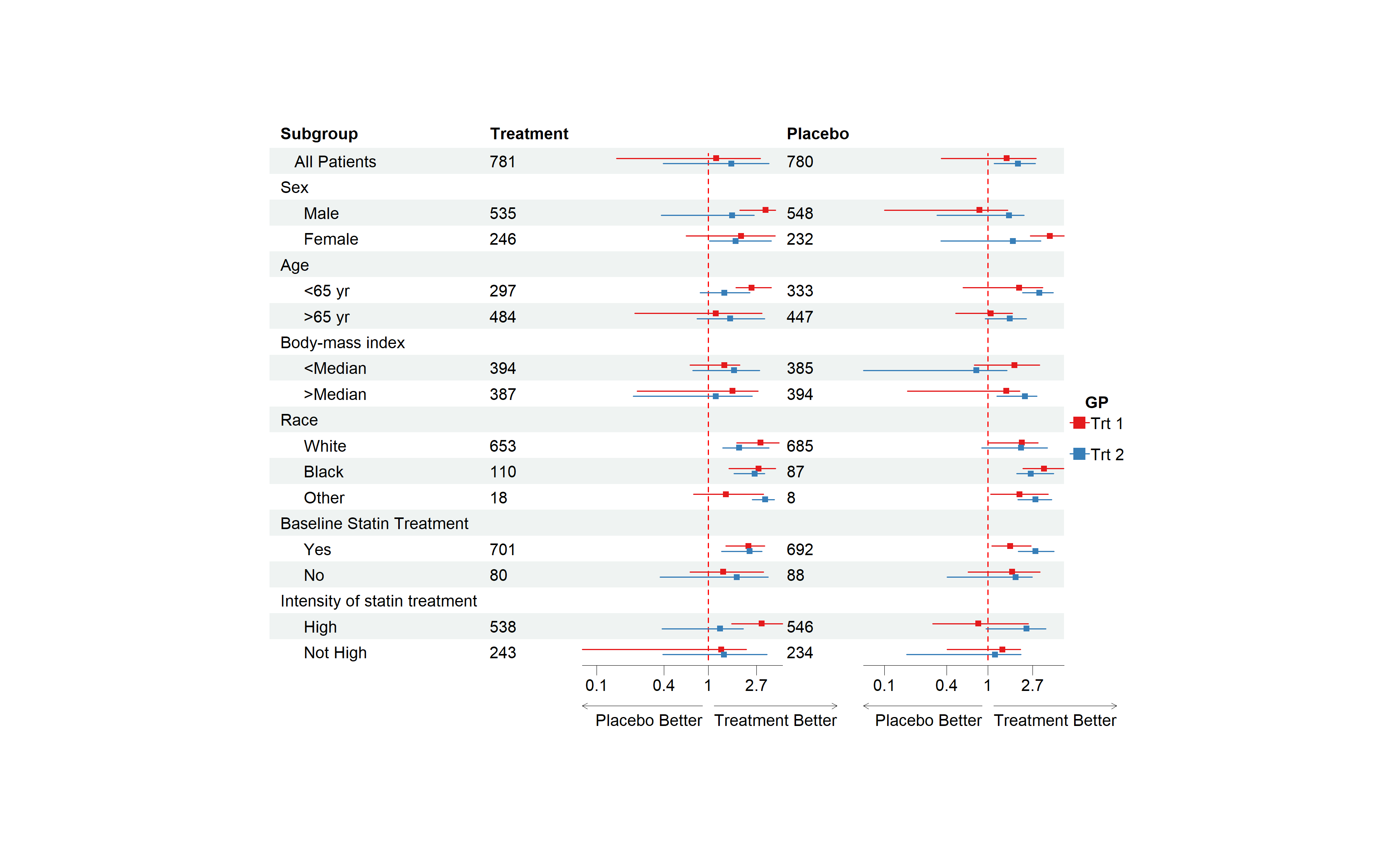
If you want to draw CIs in multiple columns, you only need to provide
a vector of the column positions in the data. As shown in the example
below, the CIs will be drawn in columns 3 and 5, with the first and
second est, lower, and upper
values corresponding to those columns.
For more complex scenarios, such as drawing CIs by groups, you can
provide an additional set of est, lower, and
upper values. If the number of est,
lower, and upper sets is greater than the
number of CI columns, the values will be reused. In the example below,
est_gp1 and est_gp2 are drawn in columns 3 and
5 as group 1, while est_gp3 and
est_gp4 are drawn in the same columns as group
2.
This is an example of multiple CI columns and groups:
# Add a blank column for the second CI column
dt$`   ` <- paste(rep(" ", 20), collapse = " ")

p <- forest(dt[,c(1:2, 20, 3, 22)],
            est = list(dt$est_gp1,
                       dt$est_gp2,
                       dt$est_gp3,
                       dt$est_gp4),
            lower = list(dt$low_gp1,
                         dt$low_gp2,
                         dt$low_gp3,
                         dt$low_gp4),
            upper = list(dt$hi_gp1,
                         dt$hi_gp2,
                         dt$hi_gp3,
                         dt$hi_gp4),
            ci_column = c(3, 5),
            ref_line = 1,
            nudge_y = 0.2,
            style = forest_style(base_size = 10,
                                 footnote = gpar(col = "blue"))) |>
  set_xaxis(x_trans = "log") |>
  set_labs(arrow = c("Placebo Better", "Treatment Better"),
           legend_title = "GP",
           legend_labels = c("Trt 1", "Trt 2"))

plot(p)