midasINLA
midasINLA provides tools for fitting mixed-data sampling
(MIDAS) regression models using Integrated Nested Laplace Approximation
(INLA). The package is designed for settings where the response is
observed at a lower frequency than one or more explanatory variables,
and supports both constant and spatially varying regression
coefficients.
Overview
MIDAS models allow high-frequency covariates to be incorporated into
models for lower-frequency responses through weighted distributed lags.
midasINLA combines this framework with INLA, allowing MIDAS
regression models to be fitted efficiently within a latent Gaussian
modelling framework.
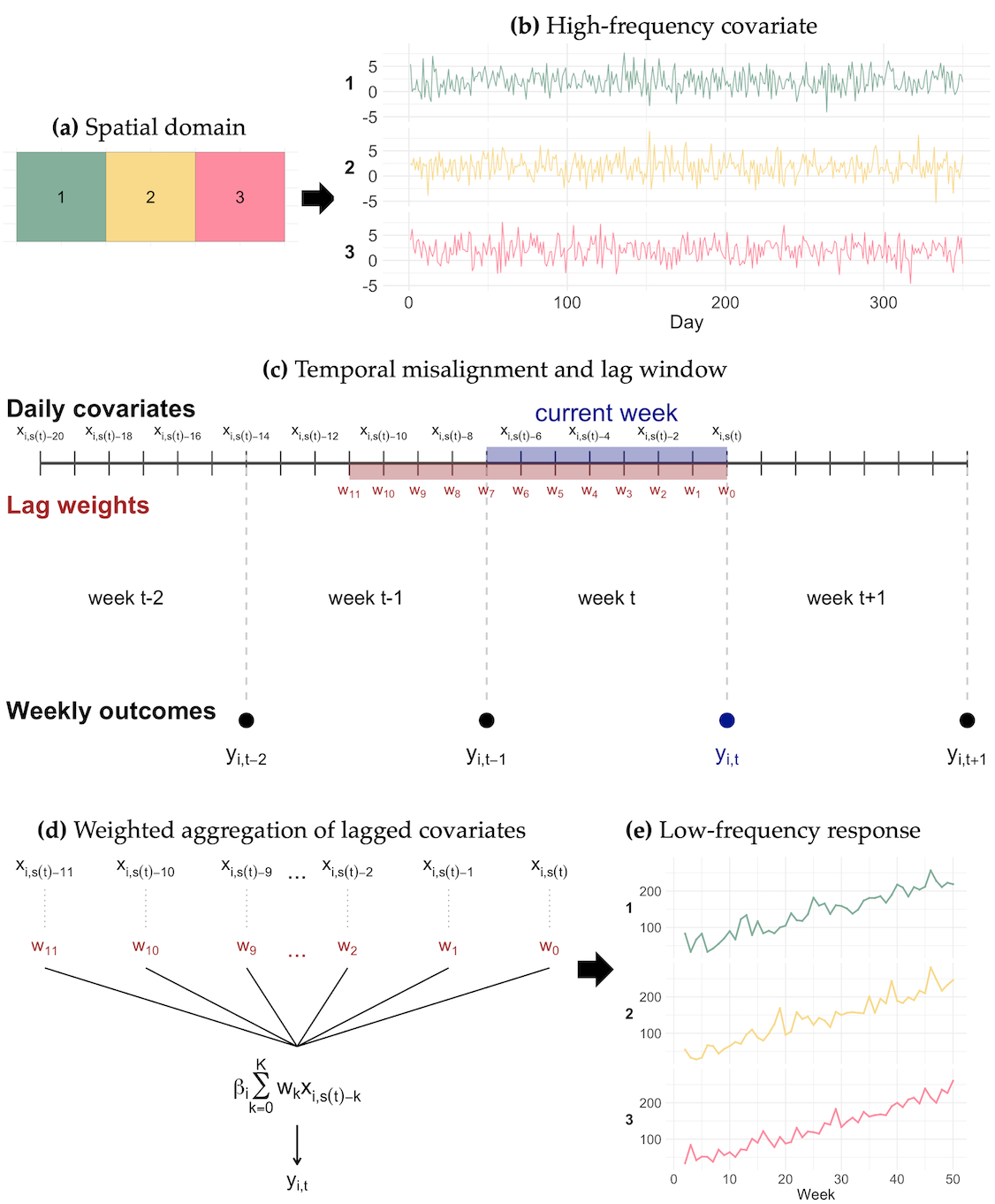
The conceptual framework for spatial distributed-lag MIDAS modelling
is illustrated in the figure below. High-frequency covariates are linked
to lower-frequency responses through weighted distributed lags, with
MIDAS coefficients potentially varying across spatial locations.
Installation
The latest released version of midasINLA can be installed from
CRAN:
install.packages("midasINLA")
The development version can be installed from GitHub using
remotes:
if (!requireNamespace("remotes", quietly = TRUE)) {
  install.packages("remotes")
}

remotes::install_github("stephen-villejo/midasINLA")
Getting started
The package includes a spatial Poisson dataset illustrating the main
modelling workflow. A typical analysis involves preparing high-frequency
covariates, fitting a spatial MIDAS model, and obtaining posterior
summaries.
library(midasINLA)
library(INLA)

data("data_spatialpoisson_example")

# Read the spatial adjacency graph
g <- INLA::inla.read.graph(
  filename = system.file("map.adj", package = "midasINLA")
)

# Prepare the first high-frequency covariate
Midas_x1 <- prepare_Minla_spatial(
  x = data_spatialpoisson_example$data_x1$x1,
  loc_x = data_spatialpoisson_example$data_x1$loc,
  constraint = "hyperbolic",
  K = 0:29,
  m = 30,
  svc = TRUE,
  svc_prior = "icar",
  g = g
)

# Prepare the second high-frequency covariate
Midas_x2 <- prepare_Minla_spatial(
  x = data_spatialpoisson_example$data_x2$x2,
  loc_x = data_spatialpoisson_example$data_x2$loc,
  constraint = "gaussian",
  K = 0:45,
  m = 30,
  svc = FALSE
)

# Fit the model
fit_res <- fit_Minla_spatial(
  formula = y ~ 1,
  hf_input = list(Midas_x1, Midas_x2),
  data = response_data,
  loc_var = "loc",
  time_var = "Time",
  family = "poisson",
  inla_options = list(
    verbose = FALSE,
    num.threads = 1,
    control.predictor = list(
      compute = TRUE,
      link = 1
    )
  )
)
Documentation
For a complete walkthrough, including posterior MIDAS coefficients,
lag weights, and predictions, see the package vignette:
vignette("midasINLA", package = "midasINLA")
Individual functions can also be explored using R’s help system:
?prepare_Minla_spatial ?fit_Minla_spatial
?compute_beta_spatial ?compute_weights
?predict_midas
Applications
midasINLA was developed to facilitate Bayesian modelling of
relationships between variables observed at different temporal
resolutions, with particular emphasis on applications involving spatial
data.
The package is particularly useful in environmental epidemiology,
climate–health modelling, and other settings where high-frequency
exposures need to be linked to lower-frequency outcomes.
Status
midasINLA is under active development. The latest
released version is available from CRAN.
Citation
If you use midasINLA in your research, please cite the
package and the associated methodological work once the relevant
publication is available.