
querying data that won’t fit in memory


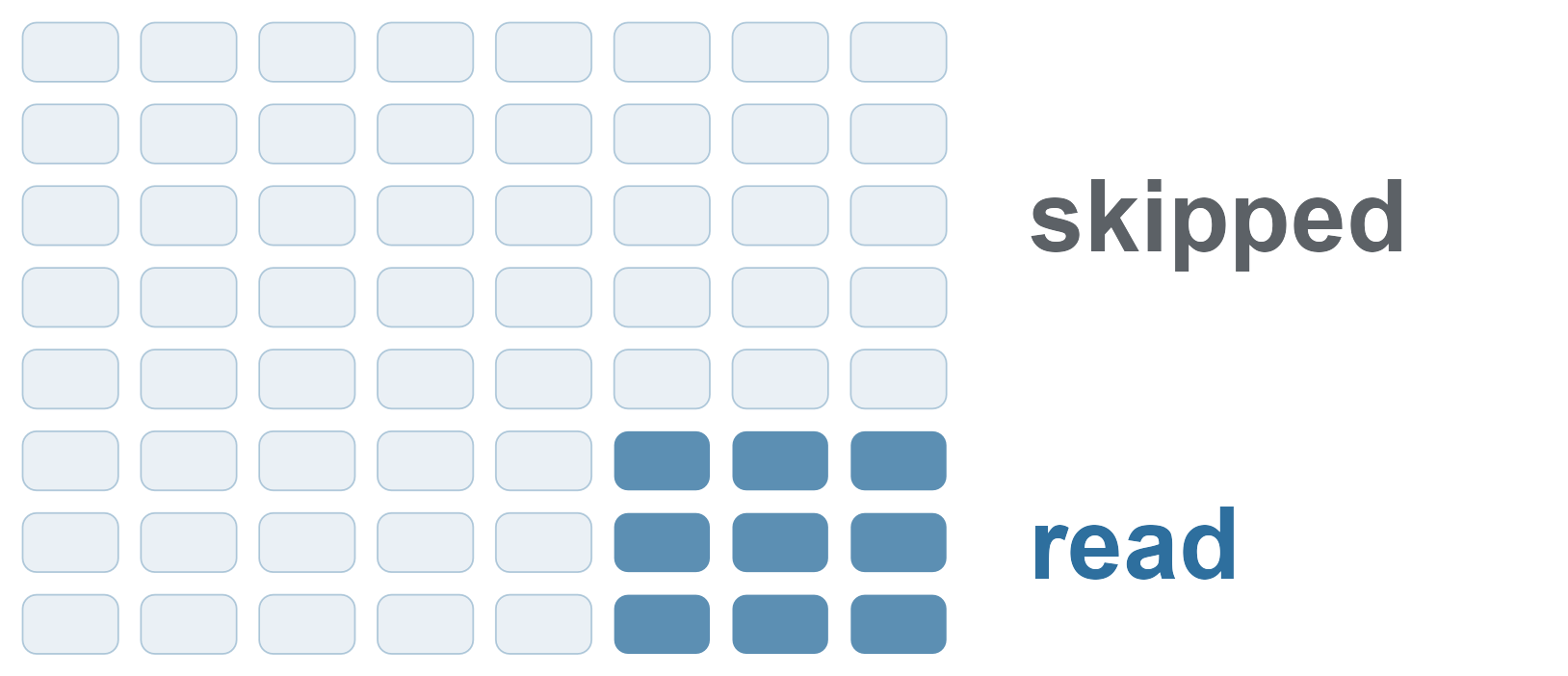
vectra runs dplyr-style
queries on files that are too large to load into memory: multi-gigabyte
CSV and Parquet files, SQLite databases, GeoTIFF rasters and its own
.vtr columnar format.
The verbs build a lazy query plan, and collect()
executes it in a C11 engine that pulls one row group (a block of rows
that is stored and decoded together) through the plan at a time. Peak
memory therefore stays bounded however large the file is. Row groups
whose stored minimum and maximum rule out a filter are skipped without
being read. You decide what comes back into R: a result small enough to
fit, or a stream that feeds a model fit or a file.
vectra supports:
filter(),
mutate(), group_by() with
summarise(), joins and window functions stream through the
engine, and sorts, joins and aggregations spill to disk when they reach
a memory budget (Working
with Large Data)..vtr, Parquet,
CSV, SQLite and GeoTIFF open into the same lazy query nodes, so one
pipeline runs against any of them (Format
Backends).levenshtein(), dl_dist() and
jaro_winkler() and the st_* geometry functions
evaluate inside filter() and mutate(), in C,
with no round trip to R per row (String
Operations and Fuzzy Matching, Geometry
functions in expressions).zonal(), focal() and terrain()
process one batch or tile at a time (Out-of-core
GIS with vectra).collect_chunked() folds a function over a query one batch
at a time, and chunk_feeder() and offload()
feed biglm::bigglm() (Offloading:
streaming, monoids, and out-of-core fits).The test suite checks the optimizer’s rewrites, such as column pruning and predicate pushdown, against base R results, and sanitizer builds (AddressSanitizer and UndefinedBehaviorSanitizer) run in continuous integration.
The release on CRAN installs as a binary on Windows and macOS, so no build tools are needed:
install.packages("vectra")The development version compiles C code, so install the build tools for your operating system first:
| Operating system | Build tools |
|---|---|
| Windows | Rtools, the version that matches your R version |
| macOS | Run xcode-select --install in Terminal |
| Debian / Ubuntu | Install r-base-dev |
Check that R can find the compiler:
pkgbuild::has_build_tools(debug = TRUE)Then install vectra:
# install.packages("pak")
pak::pak("gcol33/vectra")
vectra needs GNU make, which Rtools and the Linux and macOS toolchains include. The spatial functions use libgeos, which installs automatically as a dependency. It carries its own copy of GEOS, so no system GEOS, GDAL or PROJ is required.
String distances, geometry functions and the compression kernels use OpenMP to run on several CPU threads. Rtools on Windows and the default compiler on Linux include OpenMP. Without it, vectra installs and returns the same results on one thread.
Apple’s compiler does not ship an OpenMP runtime. The installer first
tries the runtime that CRAN’s R for macOS includes, then a Homebrew
libomp, and builds on one thread if neither works. To make
the second option available, run this in Terminal before installing
vectra:
brew install libompThe installer prints a line starting with
configure: wrote src/Makevars (OpenMP: ...). It shows the
flags it chose, or off when vectra was built on one thread.
The R for macOS OpenMP
page describes other ways to install the runtime.
tbl().filter()
and summarise().collect(), which returns a data frame.The verbs only extend the plan, so nothing is read until
collect().
library(vectra)
#>
#> Attaching package: 'vectra'
#> The following object is masked from 'package:stats':
#>
#>     filter
#> The following object is masked from 'package:graphics':
#>
#>     grid

f <- tempfile(fileext = ".vtr")
write_vtr(mtcars, f)

tbl(f) |>
  filter(cyl == 4) |>
  group_by(gear) |>
  summarise(avg_mpg = mean(mpg), n = n()) |>
  collect()
#>   gear avg_mpg n
#> 1    3  21.500 1
#> 2    4  26.925 8
#> 3    5  28.200 2
write_vtr() converts a data frame to the
.vtr format. Converting a large CSV once makes repeated
queries cheaper, because .vtr stores the row group
statistics that the scan uses to skip data.
The verbs follow dplyr: filter(), select(),
mutate(), group_by() and
summarise(), all the joins from left_join() to
cross_join() plus fuzzy_join(),
arrange(), the slice_*() family and window
functions such as row_number(), rank(),
lag() and cumsum(). select(),
rename(), relocate() and across()
accept the tidyselect
helpers. The function
reference lists every verb and expression.
Each source function opens its format into the same lazy query nodes.
# A folder of Parquet files as one table
tbl_parquet("occurrence.parquet/") |>
  filter(countrycode == "AT", year >= 2000) |>
  count(species) |>
  collect()

# A GeoTIFF raster as tidy data
tbl_tiff("worldclim_bio1.tif") |>
  filter(band1 > 0) |>
  mutate(temp_c = band1 / 10) |>
  collect()

# A SQLite database, without DBI
tbl_sqlite("survey.db", "responses") |>
  filter(year == 2025) |>
  left_join(tbl_sqlite("survey.db", "sites"), by = "site_id") |>
collect()explain() prints the optimized plan, including the
columns and row groups that the scan skips.
tbl(f) |>
  filter(mpg > 25) |>
  select(mpg, cyl) |>
  explain()
#> vectra execution plan
#>
#> ProjectNode [streaming]
#>   FilterNode [streaming]
#>     ScanNode [streaming, 2/11 cols (pruned), predicate pushdown, tdc stats]
#>
#> Output columns (2):
#>   mpg <double>
#> cyl <double>String distance functions run inside the engine, so a fuzzy filter costs no round trip to R per row.
tbl("taxa.vtr") |>
  filter(levenshtein(species, "Quercus robur") <= 2) |>
  mutate(similarity = jaro_winkler(species, "Quercus robur")) |>
  arrange(desc(similarity)) |>
collect()Geometry travels through the engine as WKB (well-known binary) in an ordinary column, so the spatial verbs stream one batch at a time like the rest. This call tags a stream of points with the polygon each one falls in, holding the polygons and one batch in memory.
library(sf)

tbl("gps_pings.vtr") |>
  spatial_join(zones_sf, join = st_intersects) |>
  count(zone_id) |>
  collect()
The spatial toolbox also covers st_* functions inside
filter() and mutate(), vector-raster bridges
(rasterize(), polygonize(),
contours()), planar overlay and coverage cleaning
(spatial_overlay(), spatial_dissolve(),
spatial_eliminate()) and routing on a line network
(spatial_network(), spatial_route(),
spatial_service_area()). Geometry operations run on GEOS
through libgeos. sf is
needed for vector file input and output and for reprojection. Out-of-core
GIS with vectra is the place to start.
A star schema registers dimension tables once. lookup()
then pulls columns from any of them, builds the joins and reports
unmatched keys.
s <- vtr_schema(
  fact    = tbl("observations.vtr"),
  species = link("sp_id", tbl("species.vtr")),
  site    = link("site_id", tbl("sites.vtr"))
)

lookup(s, count, species$name, site$habitat) |> collect()
#> species: all 500 keys matched
#> site: 3/500 unmatched keys (X1, X2, X3)append_vtr() adds new rows to a .vtr file
as new row groups without rewriting the existing ones, and
diff_vtr() compares two snapshots by key.
append_vtr(new_rows_df, "data.vtr")

d <- diff_vtr("snapshot_old.vtr", "snapshot_new.vtr", key_col = "id")
collect(d$added)   # rows present in new but not old
d$deleted # key values present in old but not newcollect_chunked() folds a function over a query one
batch at a time. It holds a single batch and the accumulator, so a
result larger than memory reduces to a small summary in one pass. This
example accumulates the cross-products behind an exact linear fit.
acc <- tbl("survey.vtr") |>
  select(mpg, wt, hp) |>
  collect_chunked(
    function(acc, chunk) {
      X <- cbind(1, chunk$wt, chunk$hp)
      list(XtX = acc$XtX + crossprod(X),
           Xty = acc$Xty + crossprod(X, chunk$mpg))
    },
    .init = list(XtX = matrix(0, 3, 3), Xty = matrix(0, 3, 1))
  )
solve(acc$XtX, acc$Xty)
Models that re-read the data on every iteration use
chunk_feeder(), which exposes a query as a resettable
generator for biglm::bigglm(). offload()
writes a prepared query to disk once and streams it back, and with a
by key it splits the query into per-key shards that each
fit in memory, so group_map() can run any R function on
each shard. Offloading:
streaming, monoids, and out-of-core fits covers both.
Start with Getting Started with vectra, which takes one query from a file to a collected result.
Engine:
Spatial:
st_* functions inside
filter() and mutate().The function reference lists every exported function, grouped by job.
Questions and bug reports go to the GitHub issue tracker. A bug report is easiest to act on with a small reproducible example, for instance made with reprex.
“Software is like sex: it’s better when it’s free.” — Linus Torvalds
I’m a PhD student who builds R packages in my free time because I believe good tools should be free and open. I started these projects for my own work and figured others might find them useful too.
If this package saved you some time, buying me a coffee is a nice way to say thanks. It helps with my coffee addiction.
vectra vendors the zstd decoder and xxHash by Yann Collet and Meta Platforms, Inc., and miniz by Rich Geldreich, Martin Raiber and contributors. tdc, the compression library written for vectra, is vendored into the package.
vectra is licensed under MIT.
Colling G (2026). _vectra: Columnar Query Engine for Larger-than-RAM
Data_. doi:10.32614/CRAN.package.vectra
<https://doi.org/10.32614/CRAN.package.vectra>. R package version
0.13.5, <https://gillescolling.com/vectra/>.
BibTeX:
@Manual{colling2026vectra,
  title = {vectra: Columnar Query Engine for Larger-than-RAM Data},
  author = {Gilles Colling},
  year = {2026},
  note = {R package version 0.13.5},
  url = {https://gillescolling.com/vectra/},
  doi = {10.32614/CRAN.package.vectra},
}